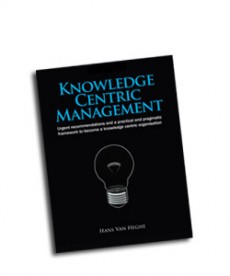
What is the background of the book?
In Western Europe, most people are knowledge workers. There was a time in the evolution of our economy when the focus was solely on production and products. Then we moved on to products and services.
Now it is clear that people are not satisfied with products and services – they want an understanding, a connection with the expertise behind a product or company.
What inspired your quest for knowledge?
Knowledge management came to be my passion through my work in communications and IT. Western Europe is a knowledge-based economy – intellectual property and experience has real monetary value that I believe is not always realised to the extent it should be. It is my aim to teach people to effectively use the knowledge that exists in their company.
How did you develop your ideas?
I took a typical engineer’s approach – studying the models for retaining and sharing knowledge, and creating methodologies that can be applied to businesses.
How does the book fit in with this?
This methodology is divided into three main sections in the book. I see it as a tool to help businesses become knowledge-centric organisations. Knowledge management is an instrument for the success of a company, and I hope I have written a pragmatic and usable framework to help organisations implement the practice, and to start to recognize themselves as knowledge-based companies.
Why is it so important to be “knowledge centric”?
Knowledge Centric Management addresses two major problems. The first is one of information overload. This has a negative impact on decision-making and leaves us less able to realise risk, as became evident in the recent financial crisis.
I see, go on…
The second problem is ageing populations, particularly in countries such as Belgium and the UK. Many people with the knowledge and expertise vital to any company are due to retire – in the Belgian government, for example, approximately 50% of members are due to retire within six years, and while no one is addressing this, the knowledge will go with them.
What solutions does knowledge management provide?
Companies are encouraged to work with results in mind, to respect the expertise of their people, and to ensure information and knowledge are clear and readily available to reuse. During the fallout from the recession, bank managers were asking me how to retain vital expertise within the company, while they were letting the people with this expertise go! Knowledge management starts with supporting your knowledge workers. They should have already seen the value of using the expertise brought to them by their staff and realised how to use it and to pass it on.
Have you seen the concept being adopted?
Yes – I have seen an increasing number of managers who view knowledge management as a strategic tool. Many of these changes were triggered by a crisis in the organisation. However, if you’ve waited for a problem before making changes, you could be too late.
What advice do you give to readers who want to become knowledge-centric?
I tell people it is a long-term process, which requires you to invest at least two years of time. Knowledge management comes across as a complicated set of ideas – through the book I want to show people how it can be broken down and implemented with great results. It is something we can all achieve.
Knowledge Centric Management: Urgent Recommendations and a Practical and Pragmatic Framework to Become a Knowledge Centric Organisation is published by Ecademy Press Limited at £29.99